|
DESCRIPTION of SPECIES
DESCRIPTION of SPECIES
Kingdom: Animalia
Phylum: Chordata
Subphylum: Vertebrata
Class: Osteichthyses (the bony fishes)
Order: Tetraodoniformes(trigger fish, boxfish, porcupine fish, puffers)
Family: Molidae
Genus, Species: Mola mola, Mola tecta, Mola alexandrini, Mola ramsayi, Masturus lanceolatus, Ranzania laevis.
put liPresently, six species are recognized within the family Molidae including: the common mola, Mola mola (Linnaeus 1758), Mola ramsayi (Giglioli 1883), Mola alexandrini (Ranzani 1839), Mola tecta (Nyegaard et al. 2017), the sharp-tailed mola, Masturus lanceolatus (Lienard 1840) and the slender mola, Ranzania laevis (Pennant 1776). All Mola ramsayi populations may turn out to be Mola alexandrini however more data are needed to confirm this statement. New species of Ranzania have yet to be formally described.
Throughout the world, a number of intriguing common names exist for ocean sunfishes including:
- Poisson lune (France) (meaning "moon fish")
- Schwimmender kopf (German) (meaning "swimming head")
- Putol (Philippines) (Bisaya dialect for "cut short")
- Manbo マンボウ (Japanese)
- Toppled car fish (Taiwanese)
- Bezador (Spanish)
- Makua (Hawaiian)
More names... |
|
| |
- Species & Distribution
- Early Life
- Diet, Size, Growth
- Parasites & Predators
 |
Mola
mola (Common mola)
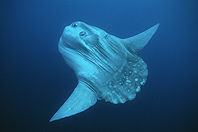
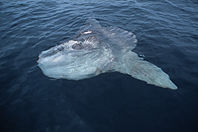
The most common and widespread of ocean sunfish in the northern hemisphere is Mola mola. These fish, like all ocean sunfishes, appear as if their bodies have been somehow truncated leaving them little more than a large head punctuated with set of long dorsal and anal fins sweeping it along like a pair of vertical parentheses. The body is less than twice as long as it is deep.
Mola mola have a rounded tail when they are juveniles which can become scalloped as they age and become larger. Their scales are multi-cusped and jagged making their skin very gritty like rough sandpaper. They are covered with copious amounts of mucus and typically silvery in color with a slight opalescent sheen although their skin can exhibit strikingly changeable, light and dark spotty patterns. Their clavus is supported by 8-9 ossicles and these ossicles are narrower than the space between them.
|
| Mola alexandrini (bump-head mola)
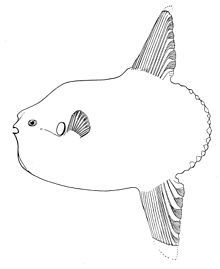
Mola alexandrini is similar to Mola mola particularly in its juvenile stages but diverges as it matures by retaining a rounded clavus. (M. mola develops a wavy clavus in its largest size.) Their rounded clavus (pseudo-tail section) is supported by 14-24 (average 17) fin rays and 8-15 (average 12) ossicles, an enlarged bulbous head, chin bump and rectangular scales. |
 |
Mola ramsayi (Short ocean sunfish)
Etsuro et al 2017 suggests that Mola ramsayi be replaced by Mola alexandrini (see characteristics above). Mola ramsayi, commonly known as the short or southern ocean sunfish, has been recorded in numerous locations in the northern hemisphere. Investigations continue to see if Mola ramsayi should be fully retired as there remains some inconsistencies in some descriptions as well as numerous individuals that have a bump head and a wavy clavus—a mix of characters from the Mola mola and Mola alexandrini/Mola ramsayi. |
| Mola tecta (hoodwinker sunfish)
Mola tecta reside in the southern hemisphere, with records from South America, Australasian waters and New Zealand. They have rounded scales and a distinct bad in the center of their clavus. |
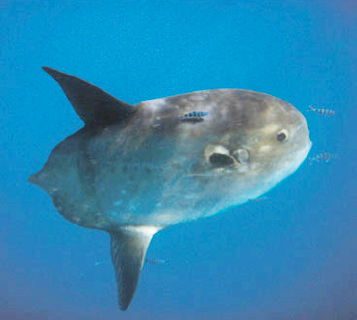
photo: Cindy Manning
|
Masturus
lanceolatus (Sharp-tailed mola)
Masturus can also reach great sizes. As their common name implies, sharp-tailed mola have a bit more to their tail than Mola mola. Similarly colored to Mola mola, they have smoother skin and produce less mucus. Interestingly, sharp-tailed molas are not consummate sunbathers and carry a smaller parasite load than Mola mola and also have a more tropical distribution. |
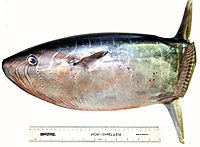 photo:
Wolfgang Sterrer
photo:
Wolfgang Sterrer |
Ranzania
laevis (Slender mola, dwarf mola)
Unlike other molas, the slender mola only reaches approx. 100 cm in total length. They are the most colorful and elusive of the ocean sunfishes. They have a smooth, thinner skin than any of the other molas and a vertically oriented mouth.
The Polynesians called these sunfish "King of the Mackerels". It was seen as bad luck to catch and kill Ranzania for such an act would render the mackerel incapable of finding their way to the islands. While this is currently the only accepted species in the cosmopolitan genus Ranzania it is very likely that there are more species waiting to be formally described. |
|
A
NOTE ABOUT NAMES
The common name "sunfish" is used to describe the marine family, Molidae, as well as the freshwater family, Centrarchidae. The common names "ocean sunfish" and "mola" refer only to the family Molidae and can be applied all three Molidae species.
The word mola comes from Latin and means millstone–in reference to these fishes’ roundish shape. The common name "ocean sunfish" comes from their habit of lying atop the surface of the ocean appearing to sunbathe. |
 |
DISTRIBUTION, MOVEMENTS and RANGES
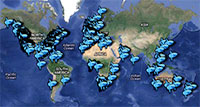
All species of sunfish are found in all tropical and temperate ocean basins.
While there is considerable overlap, there do appear to be specific preferences depending on species.
With insight gleaned from satellite tagging studies, ultrasonic tagging and our internet sighting form, we are starting to piece together the seasonal distribution of ocean sunfish populations throughout the world ocean. For example Mola mola in the Western Pacific off Japan, were recorded moving from Kamogawa Japan northwards to the Kuril Islands off Russia (Dewar et al. 2010) during the summer months. In Indonesia sunfish tagged in Bali were found to move eastward along frontal margins during the wet season (Thys et al. 2015). In the Eastern Pacific, individuals tagged in Central and Southern California migrate as far south as Baja California during the fall and winter months (Thys et al. 2016). In the Western Atlantic, individuals tagged off Nantucket and Florida in the summer months moved into the Gulf of Mexico (Potter et al. 2011; Potter & Howell 2010) while in the Eastern Atlantic, sunfish tagged off the UK moved south to Spain to the Gulf of Cadiz (Souza et al 2017; others). Sunfish off South Africa move offshore but don't exhibit substantial latitudinal migrations (Hays et al. 2009).
The northernmost record is from 70∘ 44′ N off northern Norway dating back to December 1881 (see Frafjord et al 2017 for more details) |
Molas produce an impressive number of eggs. A 1.4 m (4.5 ft) female was estimated to be carrying 300 million eggs in her single unpaired ovary. ( Note while male molas have paired testes, females have unpaired gonads.) 300 million is greater than most other fishes and to date remains the largest number of eggs ever recorded in a single vertebrate at any one time (Carwardine, 1995). Needless to say, the eggs are tiny (1.3mm in diameter) and would fit into the size of this "o".
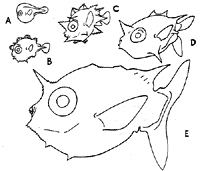
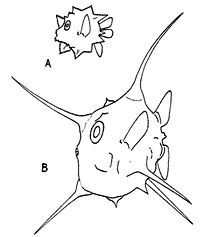
After hatching, the larvae expose their affinity to their spiky puffer-fish relatives and look more like swimming pincushions than wee molas. As they grow and mature however, their spines disappear, as do their tails. For more information on larval development of molas see the Australian Museum’s Fish Site.
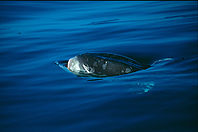
Preying
upon By-the-Wind-Sailor ( Velella velella) |
DIET
Mola mola eat a variety of foods especially when they are younger. Squid, sponges, serpent star bits, eel grass, crustaceans, small fishes and deepwater eel larvae have also been found in M. mola guts indicating that they forage at the surface, among floating weeds, on the seafloor as well as into deep water (Norman and Fraser, 1949). As they mature their diet appears to shift to include more gelatinous zooplankton—jellies including Portuguese man-o-war, Vellella, ctenophores and salps. Stable isotope work and DNA barcoding (Sousa et al 2016) has found that there is an ontogenetic shift in the composition of the Mola mola diet with smaller individuals ≤0.60 m eating more benthic prey items including crustaceans as well as teleosts while larger ones focus more on gelatinous pelagic zooplankton.
The diet preferences of Masturus lanceolatus are presumed similar to that of Mola mola. Bottom dwelling sponges and annelids have also been found in the stomachs of young Masturus (Yabe, 1953) and more small fish and various invertebrates, indicative of both benthic and pelagic foraging (Bakenhaster and Knight-Gray 2016).
Ranzania eat an assortment of crustacean, fish and molluscs including myctophid larvae, hyperiid amphipods, crab megalops, crab zoea and pteropods. Most feeding appears to take place within 150m (500 ft) of the surface (Fitch, 1969). Staff from the at Monterey Bay Aquarium report having caught Ranzania while trawling for skipjack tuna so we know these little fellows can zip along. They also have been recorded to have squid in their guts. (Nyegaard et al 2017)
|
|
|
SIZE, GROWTH and LONGEVITY
The average size of an adult Mola mola is 1.8 m (6ft) from snout tip to the end of the clavus (pseudo-tail) and 2.4 m (7 ft 10 in) between the tips of the dorsal and anal fins. The average weight is up to 1 metric ton (2200 lbs).
The heaviest mola on record came from Japan, Mola alexandrini, was 2.7 meters (8.9 feet) long and weighed 2.3 metric tons (5,071 pounds). Before this discovery the largest Mola ever recorded weighed 2235 kg (4,927 lbs) and measured 3.1 m (10 ft) from snout tip to "tail" fin, 4.26 m (14 ft) from dorsal fin to anal fin tip. That animal was struck by a boat off Sydney, New South Wales, Australia in September, 1908 (Carwardine, 1995). It is likely there are larger molas but there was not a scale available to take a formal measurement.
No data exist on how fast mola grow in the wild but one Mola mola individual in captivity at the Monterey Bay Aquarium gained 364 kg (800 lbs) in 14 months. Fattened up on a diet of squid, fish and prawns, this fish had to be airlifted out by helicopter and released into the bay after outgrowing its million gallon tank. (Powell. D. 2003 A Fascination for Fish, UC Press/Monterey Bay Aquarium Series in Marine Conservation.)
The longevity of molas in the wild is also a mystery although Kamogawa SeaWorld in Japan housed the same individual for more than10 years in captivity. (Nakasubo et al. 2007, Growth of captive ocean sunfish, Mola mola Suisan Zoshoku 55: 403-407.) A growth curve derived from repeated measurements of captive individuals estimated animals with a total length of 3m would be approx. 20 years old (Nakatsubo, T. 2008 A study on the reproductive biology of ocean sunfish Mola mola. Dissertation. International Marine Biological Institute. Kamagawa Sea World, Japan. Liu et al 2009 examined vertebral growth rings in Masturus from Taiwan and estimated lifespan of individuals greater than 2 to 23 years for females and 1-16 years for males. Accurately estimating and measuring the age of wild mola remains a work in progress. |
 |
COLORATION
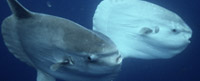
Mola come in a variety of gray and white patterns with some sporting your basic gray motif while others go for the more polka-dotted appaloosa style. Many also have a slight iridescent sheen. Certain geographic areas seem to have discrete color patterns—for example the mola in Bali appear darker than those off Southern California. Molas may have specific traceable patterns individual identification research is taking place in Bali and Galapagos.
Mola are capable of color changes particularly when stressed or under attack from a sea lion or other predator and can turn from light to dark within a matter of moments. |
|
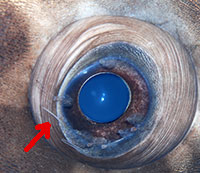
Lepeoptheirus sp. or Caligus sp .
Click for detail. Can you count them all? Photo courtesty Chris Potgieter
Sept 30,2007 at Crystal Bay, Lebongang,
Bali Dive depth
was 45m at the cleaning station.
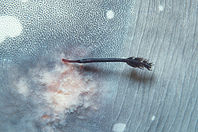
Parasitic copepod
(Pennella filosa)
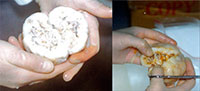
Didymozoid trematode
Removed from the inside of a Masturus lanceolatus in Hua
Lien Taiwan--supposedly 1 in 100 Masturus there have these tumors.
|
PARASITES
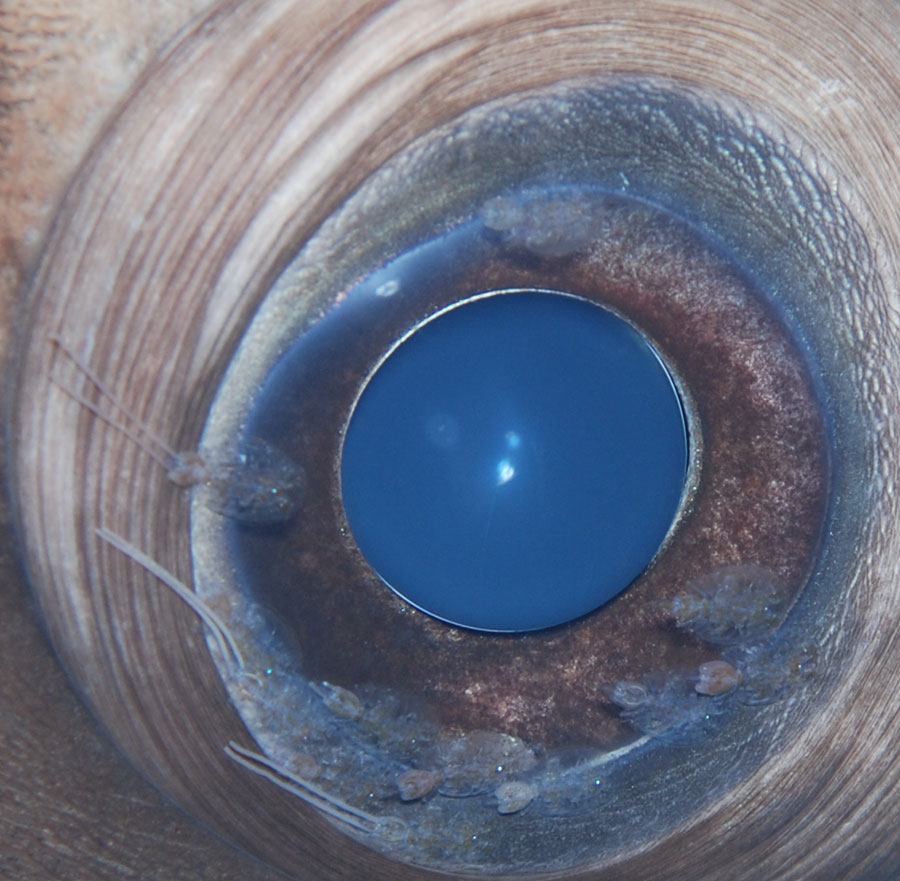
Since parasites often sport multiple hosts, they can offer valuable insight into ocean sunfish interspecies associations. For instance, one sunfish parasite is the larval stage of a shark tapeworm so at some point the mola most likely falls prey to shark thus enabling this parasite to complete its lifecycle. For a list of known parasites of the family Molidae click here
The common sunfish, Mola mola, is infamous for its impressive parasitic load. Some 40 different genera of parasites have been recorded on this species alone. In fact, even their parasites have parasites–a fact reminiscent of Jonathan Swift’s quip:
So, naturalists observe, a flea
Has smaller fleas that on him prey;
And these have smaller still to bite ’em;
And so proceed ad infinitum
Masturus lanceolatus are not as heavily parasitized as Mola mola. And while they dive to great depths (Seitz et al XXX), they do not appear to engage in sunbathing to the same degree. Little is known about the parasites of Ranzania, the slender mola
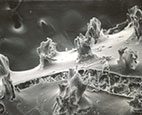 Mola mola
 skin 88x |
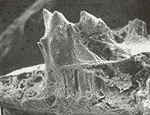 Mola mola
 scales 176x |
Photomicrographs
|
|
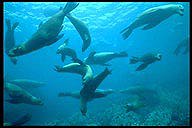
Sea lions (Zalophus
californianus)

Bat stars (Asterina
miniata) consuming dead sunfish
|
PREDATORS
There's safety in great size for the ocean sunfishes but on the
road to largess, they are open to many dangers. Bycatch
through fishing certainly takes a toll on mola populations. And
parasites presumably claim quite a few
lives as well. Other predators include orcas (Gladstone, 1988) and
sea lions.
During the fall months
in Monterey, California, sea lions can be seen ripping the fins
off sunfish and slamming the dismembered bodies against the sea
surface. Presumably this action helps the lions tear through the
molas’ skin which is leathery tough and several centimeters
thick in places. However, after tossing the bodies through the air
for several minutes, the lions often simply abandon their prey.
Tragically the hapless, finless molas unceremoniously sink
to the seafloor and are consumed slowly by bat stars.
Little
is known about predation on Ranzania. However an adult
female (335 mm in total length) was found in the stomach of
a marlin off Hawaii. Numerous
Ranzania youngsters have also been found in the guts of
mahi mahi Coryphaena hippurus. (Sherman, 1961)
|
|
|
|
 Facts
Facts K-12
Lessons
K-12
Lessons Lore
Lore Man
& Mola
Man
& Mola Art
Art Poetry
 Photos
 Videos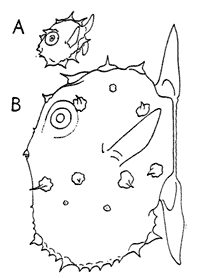
 info@oceansunfish.org